Showing posts with label ornamental areas. Show all posts

Saturday, March 23, 2019

Pinke's Planting

The trees just south of the 11th tee have been down for a couple of months now and the positive results of this project have become increasingly obvious.  Below is a picture taken from the 11th tee before the removal of the trees and then the next picture was taken just the other day.

Maybe even more impressive is the view from the south looking back toward the tee.  Here's a before and after picture from that viewpoint.  In these pictures you can really appreciate the size of the trees.

Now of course the benefits of this project are numerous.  For one thing nobody is ever going to have to clean up after those trees.  Falling debris is a year around occurrence with trees that size.  Secondly, the freshly paved road (which is coming very soon) will enjoy decades of strength and smoothness since it wont be compromised by roots heaving up or falling branches.  Thirdly, some very nice native oak trees were released by this project giving them a second chance to live a full life.  I guess you could say a lot of grass plants were also released by this project since there's no question the surrounding turf will greatly benefit from the increase in sunlight.  We must mention the issue of safety.  This project has now given everyone the opportunity to hit their desired shot shape from the tee.  That means it's a lot safer for those people on 16 green since far fewer errant tee shots will be in that vicinity.  Lastly, and most likely the best benefit of this project is simply better golf.  As I just mentioned now you can hit a fade or a draw from the tee which means you have a choice.  Whenever you stand on a tee and have choices or decisions to make, the tee shot all of the sudden is more interesting and that is just simply better golf.  Now I have to give credit where credit is due and Jeremy Pinke (our horticulturist) is certainly due credit and praise for his work on the planting which replaced those trees.
You can see that the planting effectively buffers the roadway and the new trees are a variety that will max out at a height of 30' so they will never cause problems similar to those we experienced from the big firs (i.e. shade, bad golf, road up-heaving).  This planting was quite a project in of itself.  First of all, the plants were donated by some neighbors with the stipulation that we cover the cost of removal and replacement.  The plants had outgrown their space.  Here's what they looked like before transplanting.
After most of my staff teamed up and hand dug around each of these plants, Jeremy then used a machine to load them onto our trailer. 
The large plants then had to be off loaded at the golf course, and then transported to the planting area on 11 tee.
The whole process took several days, and ironically it all came together on a couple snowy days in early March. I honestly had fears that this project would start at the same time the grass would start growing.  No one could have predicted that the course would be covered in snow on March 5th.  The timing just couldn't have been better and it was fun watching the crew work together to get this project done.  I provided the tools, but it was all coordinated by Jeremy and as always he never disappoints.  The planting looks really good, but you should know we're going to add several more plants to increase the overall density.  When you see Jeremy, give him an attaboy.  This was a tough project and he's pretty proud of how it's turned out so far.  

Saturday, March 1, 2014

The Island

This picture was taken in 1989 before the "new holes" were completed and you can see that the original island planting was rather unimpressive yet composed of plant species endemic to the area.
 Then at some point the planting was redone and in this picture it's hard to tell what exactly was planted but it looks pretty much like a mixture of several ornamental, non native type plants.
Most recently the planting on the island was again non native plants and this is one of the reasons that we just recently started to revamp the island again.  Another reason was the weeping willows, which are native to China, had gotten so large that they were interfering with golf.  They were blocking the views of both the 13th and 15th tees which created a safety concern and from the 15th tee, the view of the left side of the target green was being obstructed.  Rather than just cutting down the willows, it was decided to completely replant the island and attempt to make it look more natural by using plant material which is native looking.
 First we just wiped out everything which was rather challenging considering you can't just take a backhoe over there and dig the stuff out.  The crew dug out everything by hand and shuttled the stuff over piece by piece using the row boat.
 Then we rented a large construction fork lift and moved all the new plant material over.  This picture makes it look like it was an easy job but trust me, the fork lift could barely reach the island  so we had to push the limits of the machine.
 We also took over a pallet of soil amendment to aid in establishment of the new plants.  Jeremy and Gabe worked really hard on this project, and I mean really hard physically.  It was a tough job and took a lot of teamwork.
 So here we are today.  Almost finished and I think it is looking great all things considered.  It really is hard to make the island look natural.......mainly because of the island itself.  It is rather unnatural to have a perfectly round island in such a small body of water.  We have tried to come up with other schemes to maybe rebuild the island or just simply remove it but right now the Committee would rather focus dollars elsewhere.  So for now at least, the new evergreen island planting is in place and we will see how it looks once completed and grown in.  This picture was taken from the new black tee on 13 so you can see now that there is good visibility of the target fairway, and the 15th tee.
 This week we also finished grading the surrounds of the the 13th green.  We're going to finish this up this week and I can't wait to see grass on this new wrap of fairway turf.
One last picture.  Check out the new sunshine on the 15th green.  You can see my shadow and the stump in the foreground.  A couple weeks ago that green would have been smothered in shade at this time of the day.

Saturday, December 28, 2013

Just Get'n it Done!

 The work continues behind #2 green.  The communication cable conduit is installed and now it's just time for restoration.  The good news here is that we wont just be restoring the area, it will be an improvement.  This area has been one of the most shady spots on the course for as long as I can remember.  Once we began the tree management plan in 2009, things have gotten a lot better here because our goal was to increase sunlight to the putting surface which incidentally brought more light to the area behind the green.  Now after the renovation which resulted in a short mowed collection area behind the green, the need for sunlight is now increased here since the expectation for quality turf has increased for this area.  Once we started mowing this area as short fairway type turf this past spring, it quickly became apparent that this area would not support that type of sward without some sort of renovation.  Since we have disturbed the area with the conduit installation, it seems obvious that this would be the opportune time to also renovate it as we restore it. It's really quite simple, all we are going to do is bring in 6 - 8 inches of sand so we can smooth the area and thereby cover the shallow roots that are interfering with the quality of the turf.  This means we will also be able to regrade the area to improve the runoff so that golf balls have a better chance to stop on turf and not run through into the garden or out of bounds.
 In the center of the above picture you can see the open space and the exposed fence.  This openness in  the result of removing some of the scrubby brush that was shading this area and creating a dense vegetative spot that was swallowing golf balls.
Now here is a picture of the same spot after Jeremy and Gabe transplanted some new shrubbery.  This new stuff is perfect because now we can maintain them to just the right height which screens off the fence and maintenance facility without shading the turf, but it also is airy near the ground so you can find your ball or maybe even get a club on it.   These shrubs came from the area around the second tee where have another renovation project going. 
 The above picture of the 2nd tee was taken back in September.  Check out the dead tree right in the center of the photo.  That is an old native yew.  I'm not sure why it passed away but right now we are working in here removing it along with some blackberry bushes and the like.
Above you can see a close up of this area before we started the work.  Basically it's just a bunch of native scrubby stuff that has been allowed to grow out of control so since we are in here getting out the dead yew, we might as well clean it up a little and put something in here that is native looking but yet not noxious like blackberries.

 Here's how it looks today during the removal phase.  Incidentally, as we started digging around in here, we found evidence of the old teeing ground perimeter which we will be able to restore once we start putting this area back together.  Once complete, we should be able to play the hole from 370 as it once was versus today's yardage of 360.
 Richard was leading a group that was working on renovating the stairs to 10 tee.  They turned out great.  Nothing fancy here, they just took it apart, rotated the timbers so that the rotted side was down, and put it back together.  I'd say they're good for at least another decade. The simple construction and materials are very functional and low maintenance.  Boo say's nice work guys.  It's just so nice to be getting some stuff done.  When we aren't cleaning up after wind storms, we can put a lot of energy into just fixing things up.  This is when we can really make a difference.  It feels better working on updating or improving areas versus just cleaning up after mother nature's temper tantrums.  
 So how's the turf???  Well considering we set several record low temperatures early this month, I'd say things are looking great.  Obviously the turf looks good in this picture, but up close as in the picture below, you might think it looks a little off color. 
 You can see that there is a lot of leaf blades that are brownish or yellow, but there is a lot of leaf blades that also green and healthy.  We really came out of the deep freeze in good shape.  The turf is hardened off nicely with a little growth.  With turf like this we can produce some really nice winter putting surfaces.  Get out there and enjoy.

Friday, December 21, 2012

Intermission

Today is the official beginning of winter and so it seems appropriate that we started the week with a little of the white stuff.  It made for some interesting pictures of the new bunkers.
The fescue bullnose faces are so vertical that snow was unable to come to rest on them which left ribbons of green throughout the white landscape. 
Building bunkers in these conditions is difficult.  Considering the weather and the upcoming holiday season, we are taking a break from construction.  Another complication is that our sod is coming from the east side of the state.  The east side of Washington is a high desert climate so it is really cold over there right now.  So cold that the ground is frozen and they are unable to cut sod.  We knew this time would come but we really thought it would come sooner.  We did not expect to get so many bunkers built before the freeze.  To date we have built 23 bunkers and filled in 8.  We are exactly halfway done with the project so this is a perfect time for an intermission before we get back at it and finish this thing.  Since I don't have new bunkers to show you, I'll take this opportunity to discuss some other aspects of the project.  Specifically, I want to show you the unique features of what will be the new 6th and 18th teeing ground.
This diagram shows how the new mowing pattern will include all the tees of the two holes into one area.  Notice the words "new tee".  Both holes get added length and yes, if two groups are hitting from the black tees at the same time, one will probably wait for the other since they'll be hitting almost directly over each other.  There isn't too many rounds played from the black tees so this potentially awkward situation won't happen very often.
Most of the rounds played at Tacoma are from the blue tees, and this diagram shows how during a normal setup, there is no safety issue and some groups might choose to hit at the same time, but I expect here too folks will wait for one group to play first, or maybe just alternate between individuals of both groups.  It's going to be interesting to see what people do.  What I love about this new combined teeing ground is the options for playing the two holes which adds almost an infinite amount of variety.
For example some days you'll walk up to this configuration.  What I love about this is that this is the way these two holes where played before the rerouting in 1989.  In other words, this is the way these two holes were played for 83 years.  This is going to be fun. 
This is also going to be fun.  We can set it up like you see here which is a combination of the old 6th hole and  the new 18th hole.  A very unique situation is created here where people will be teeing off right next to one another.  I just love this.  Now of course to create this teeing ground, we had to remove a planting of ornamental shrubs that separated these two tees.  Ironically, I myself built this planting as the Assistant Superintendent in 1994.  That's really kind of weird that I've been here long enough to start changing things I already changed.  Anyway, this is such a great idea, I wonder why we just didn't do this back in 1994.  Let's look at some pictures I took of the area today.
This is the new flat area of the teeway that will be the black tee for the 18th hole.  From here she plays about 560 yards.
Here I'm standing on what will be the new black tee for the 6th hole.  She plays about 195 from here.

Here is the shot from the original routing which is playing down today's 18th hole from today's 6th tee.  Whats really interesting here is that curbing in the right side of the photo.  Notice how it points down the 18th fairway.  Yes, that is the same curbing that was there when the hole did play down that fairway.  Nobody since then, including myself has bothered to replace, or relocate that curbing.  Well I can tell you when this new combined tee is grown in, the plan is not just to remove the curbing you see there, but the entire cart path system.
Here's a spot that is right in the middle of the two blue tees.  It was recently part of an ornamental planting bed, but soon will be flattened out to be teeing ground.  I'm guessing no one has ever really hit to the 6th green from this area, but I'm certain we will in the near future.  It's a great angle to this green.
A little further up is an area that will be a new angle from the white tees.  Again, I don't think at any time in club history was this hole ever played from this area.  Now, I'm not sure what you're thinking about all this, but personally I think this new combined teeing ground might be one of the greatest teeing grounds you ever play.  Unbelievable variety can be created, especially for the 6th hole.  In fact, considering how often the flag position changes, it could be that you never play the 6th hole from the same yardage and angle more than one time for the rest of your life.  If you don't think that's pretty neat, then you just don't know good golf.

Wednesday, June 15, 2011

Dr. Pinke

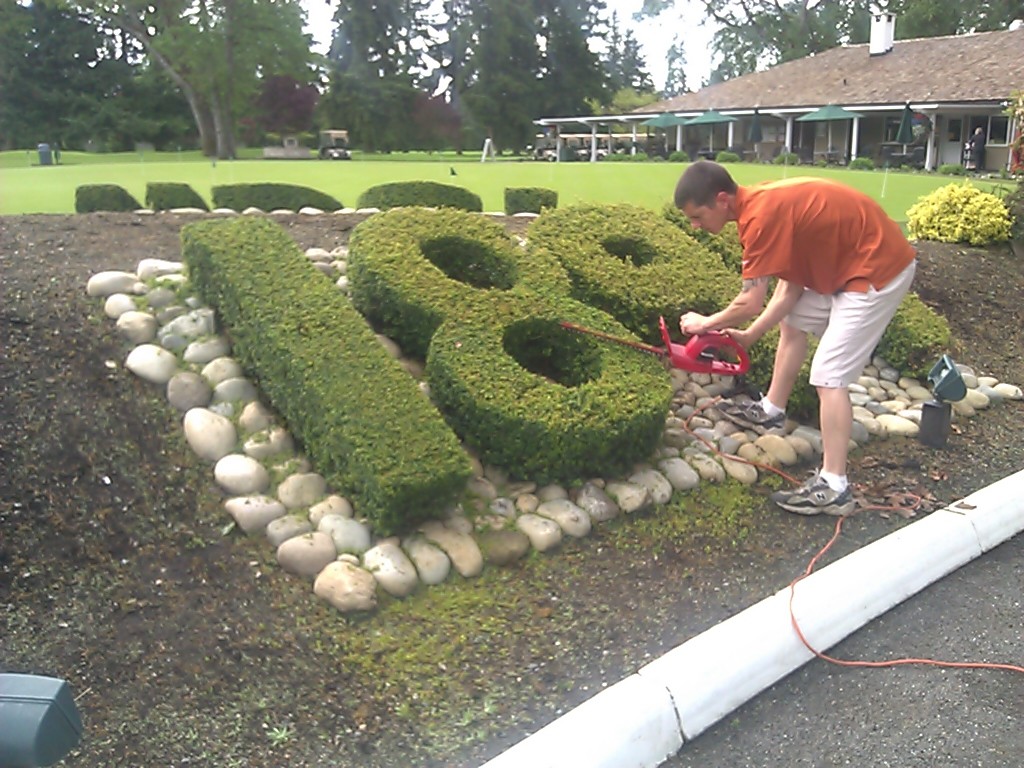
Here you can see Jeremy Pinke our Horticulturist using the touch of a surgeon on the 1894.  Today it's clear what an incredible job Jeremy does since everything is starting to bloom and he's seen all over planting annuals.  What most folks don't know is how many countless days Jeremy puts in preparing for the growing season.  All fall, and winter he daily blows the parking lots, and rakes the beds.  Every shrub gets pruned.  Dozens of shrubs are dug up and relocated.  Flowers are ordered months in advance.  The custom flower baskets are planted at the nursery in February.  There is simply hours and hours of planning and hard work that goes into the presentation that Jeremy gives us each summer.  So right now is when all that work pays off and he gets the chance to show off.  Don't be afraid to tell him next time you see him that you really appreciate all that he does.  And even more so, tell him the same thing on a winter day when it may not be so obvious that he makes such a difference.  Jeremy, thank's for all that you do, we can't imagine what it would be like without you here on the team.

Monday, June 13, 2011

Wet Feet

Some of you may have noticed that several of the plants behind 12 green aren't well.  In this picture you can see a hole where we removed a struggling shrub, and if you look close you can see that the hole is full of water.  Remember this area is a new planting that was as a result of the sewer installation project.  This area was excavated to a depth of 7 or 8 feet before the sewer was laid, and then we imported several yards of fill to shape the mounds.  In that process several different soil types were layered in and compacted by heavy equipment.  The result is that several areas in this new complex have poor drainage so some of these plants have wet feet.  What needs to be done is we should replant these shrubs and dig a hole three times as big as necessary so that we can put several inches of gravel in before replanting.  This should keep the roots from drowning. When can we do this??  Right now is a very busy time so it will have to wait but it is on our "to do" list.  Below is a picture of this area before restoration was complete.